
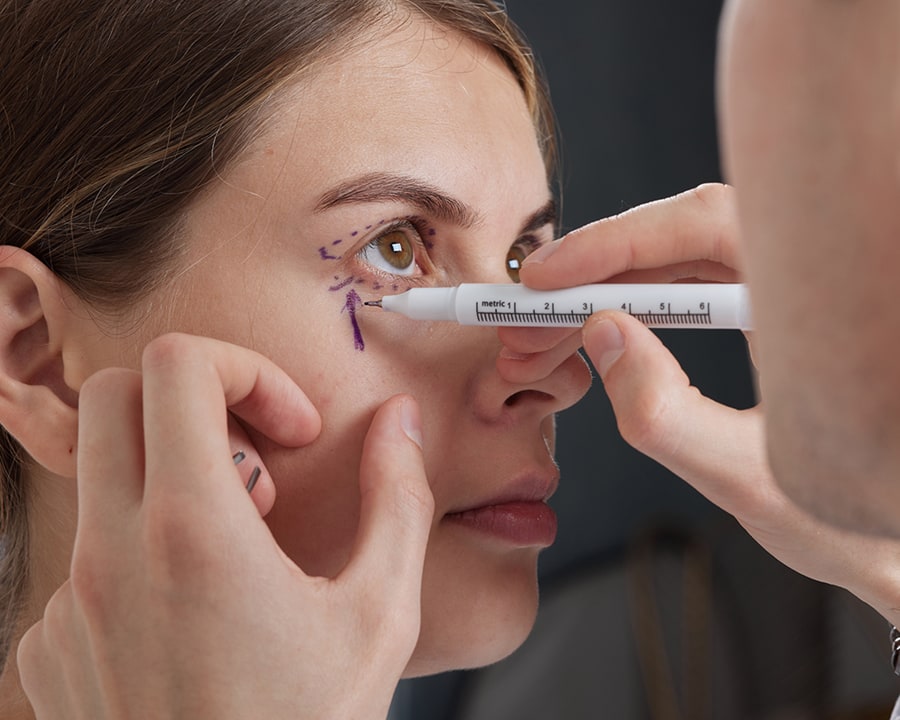
What is Blepharoplasty?
As we age, excess skin and fat (puffiness) can appear on the upper and lower eyelids. In the upper eyelids, this may result in obstruction of the peripheral vision, decreased contrast sensitivity, and the illusion that the eyes are smaller. The eyes may also feel tired or like they want to close on their own. A person may feel they look sad, tired or angry when they are not. In the lower eyelids, fat can bulge forward creating the appearance of a “bag.” The surgical procedure used to reverse some of these aging changes to the eyelids is called a blepharoplasty. The treatment plan is tailored to each patient. Your surgeon will discuss the changes that may be possible and the limitations of treatment.
Upper Eyelid Blepharoplasty
An upper eyelid blepharoplasty consists of removing some excess skin and fat to give the appearance that the eyes are wider open and to create a more youthful appearance to the eye area. During this procedure, the incision is made in the crease (fold) of the eyelid and is discussed with you as part of the surgical plan. During a lower eyelid blepharoplasty, a small amount of fat is often removed through an incision on the inside of the eyelid. Often the skin of the lower eyelid is treated with a laser or chemical peel at the same time to help tighten and rejuvenate it. A ptosis (“droopy eyelid”) repair or brow surgery can be done at the same time as blepharoplasty, if necessary. Blepharoplasty is often combined with brow surgery, Botox® and facial fillers when appropriate to the treatment plan.
Outpatient Procedure
Both procedures are performed either in the office or in an outpatient surgical center. Recovery varies. Discuss aftercare and expected healing with your surgeon. Both men and women often undergo blepharoplasty. During your surgical consultation, board-certified, fellowship-trained ophthalmologist Dr. Zamecki will discuss a customized surgical plan that is most appropriate for you. Katherine J. Zamecki-Vedder, MD, FACS performs hundreds of blepharoplasties a year and also offer surgery using a CO2 laser (laser blepharoplasty). The laser can also be used for skin resurfacing, a technique very often used in combination with surgery to rejuvenate the lower eyelids.
Get Started
An upper eyelid blepharoplasty may be covered by your insurance. Call 203-791-2020 to schedule your blepharoplasty evaluation with Katherine J. Zamecki-Vedder, MD, FACS.
Information is educational and does not replace an individual evaluation. Discuss treatment options, limitations, preparation, and recovery with your clinician.